
The 4 Types of Sentence Structure
The 4 Types of Sentence Structure
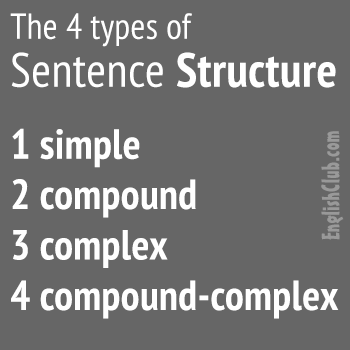
Simple Sentence Structure
A simple sentence consists of one independent clause. (An independent clause contains a subject and verb and expresses a complete thought.)

- I like coffee.
- Mary likes tea.
- The earth goes round the sun.
- Mary did not go to the party.
A compound sentence is two (or more) independent clauses joined by a conjunction or semicolon. Each of these clauses could form a sentence alone.

- I like coffee and Mary likes tea.
- Mary went to work but John went to the party.
- Our car broke down; we came last.
Complex Sentence Structure
A complex sentence consists of an independent clause plus a dependent clause. (A dependent clause starts with a subordinating conjunction or a relative pronoun, and contains a subject and verb, but does not express a complete thought.)


- We missed our plane because we were late.
- Our dog barks when she hears a noise.
- He left in a hurry after he got a phone call.
- Do you know the man who is talking to Mary?
Compound-Complex Sentence Structure
A compound-complex sentence consists of at least two independent clauses and one or more dependent clauses.

- John didn't come because he was ill so Mary was not happy.
- He left in a hurry after he got a phone call but he came back five minutes later.
1. A simple sentence consists of
2. An independent clause contains
3. A compound sentence consists of
4. Independent clauses can be joined by using
5. Which is a compound sentence?
6. A complex sentence consists of an independent clause plus
7. A dependent clause can begin with a relative pronoun or a
8. "I like him because he’s funny." Which is the dependent clause?
9. Which is a complex sentence?
10. A compound-complex sentence consists of two or more independent clauses and



No comments: